As spring warms into summer and my classes wrap up, I have been reflecting on the stupendous amount I have learned at the University of Glasgow while earning my MPhil of Book and Paper Conservation. Being part of the inaugural year of the program, we had a relatively small course with myself and three other students. I finished the year as the only student specializing in Book and Archival Materials. However, for the majority of the first year, most of our courses were together. By the end, we began separating into our specializations, meaning I had one-on-one courses with the tutor. Each semester had three courses, in addition to museum visits across Scotland, practical work, workshops, assessments, essays, and reading. Oh, so much reading. Considering it has only been nine months; it is bewildering to consider everything my cohort and I accomplished in this short time. I leave this year having grown in my conservation skills, writing, and knowledge around bookbinding and its history.

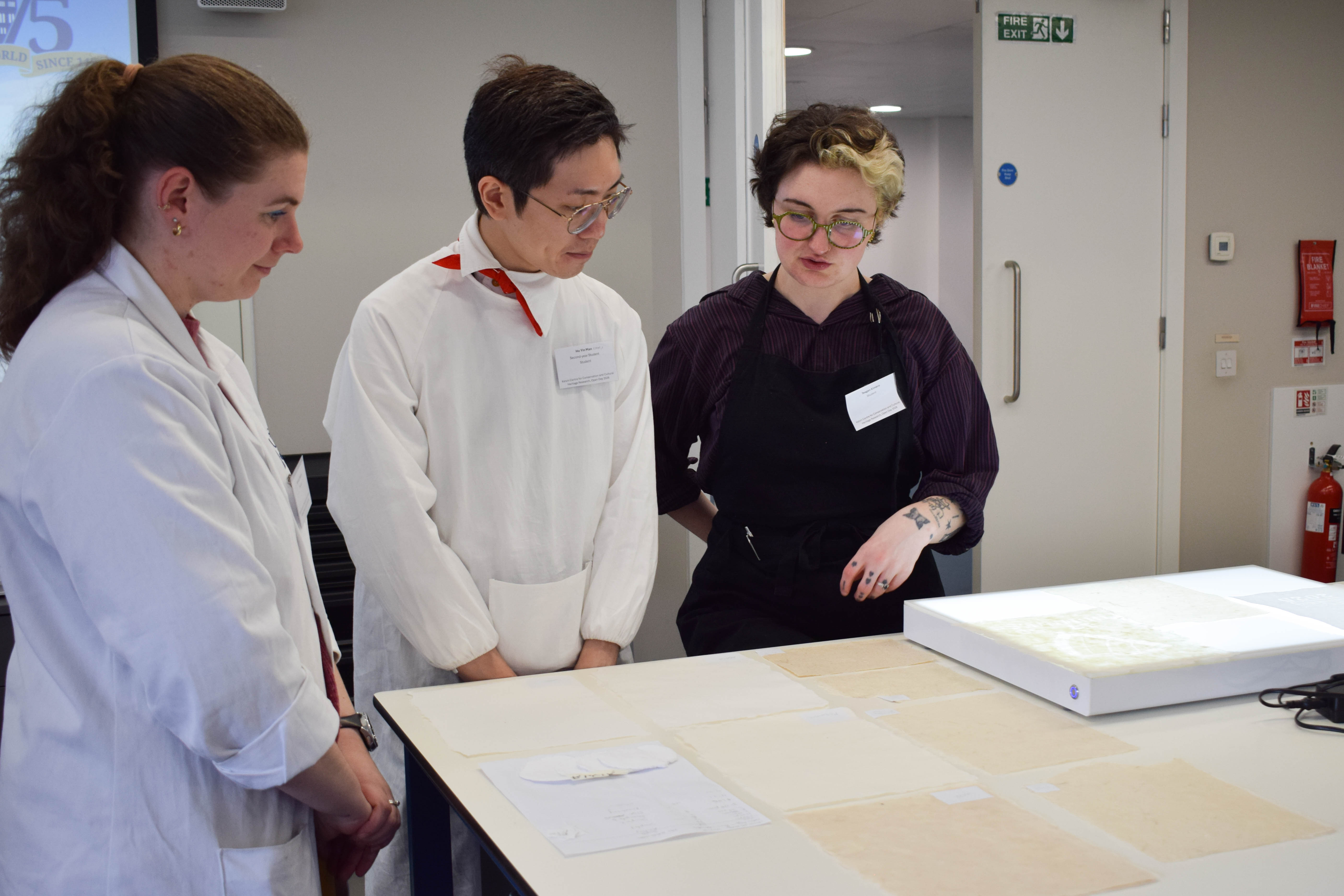
Students talking about the handmade paper on our course open day. Image from Sarah Foskett, 15 May 2026. 
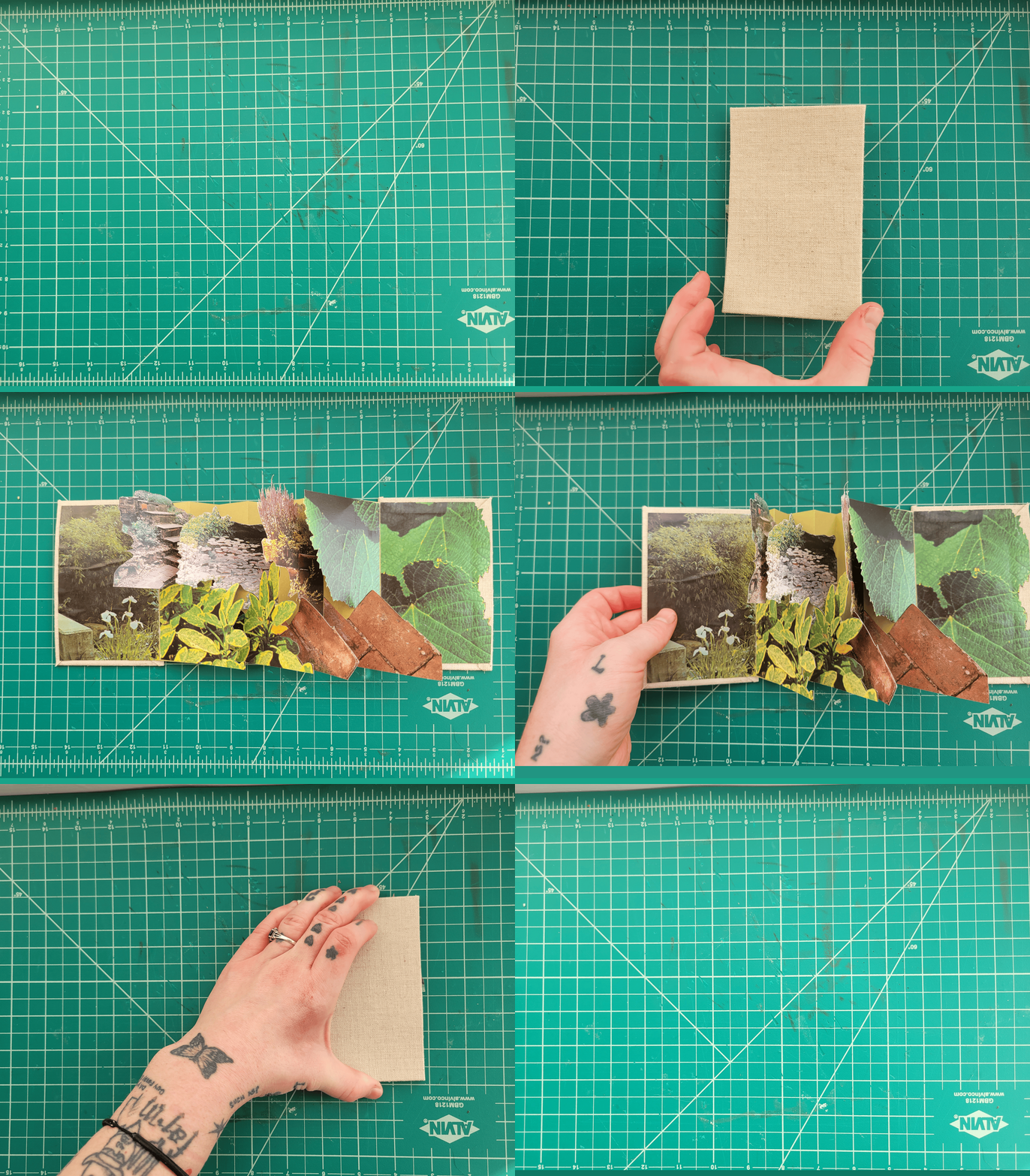
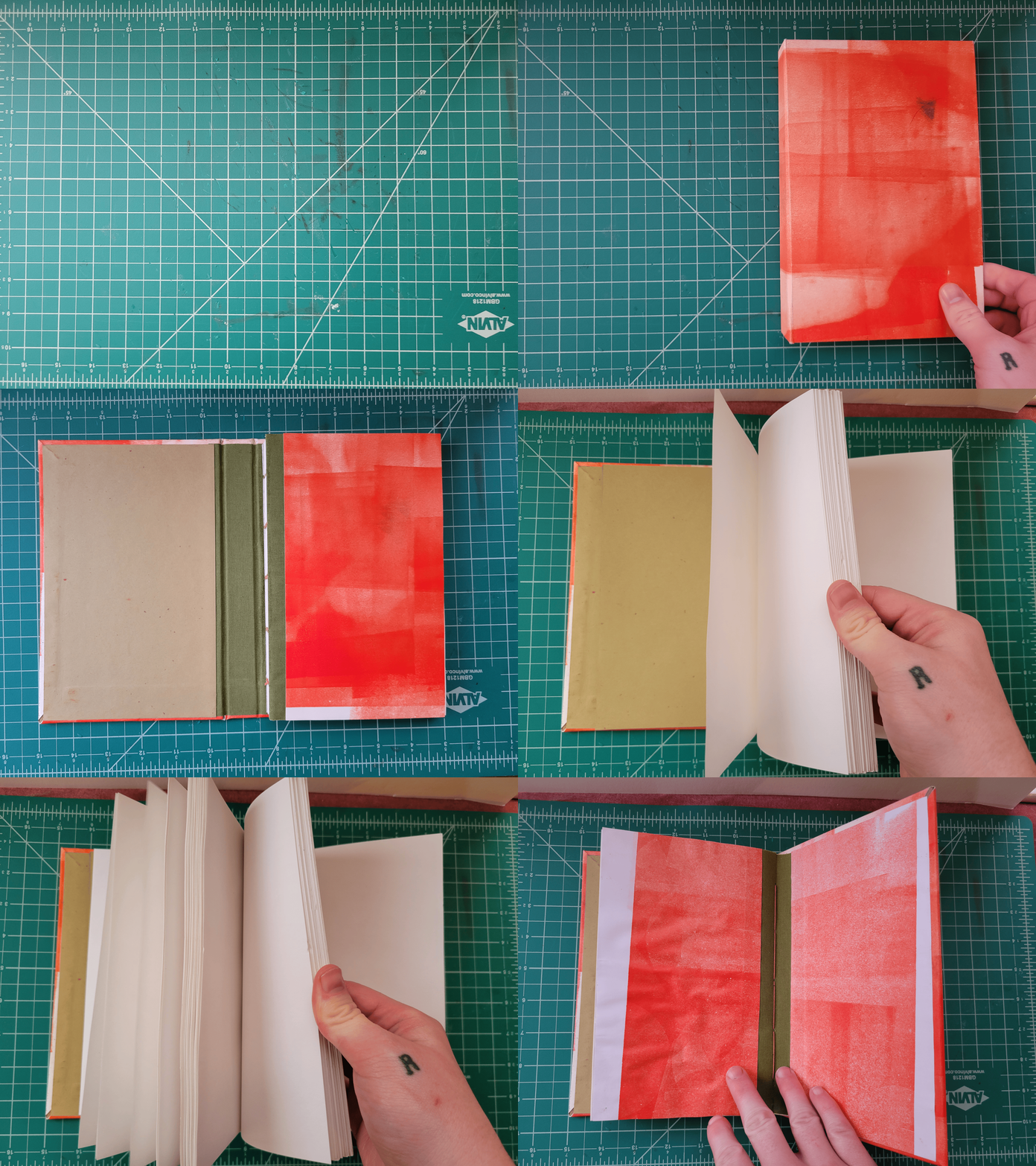
Showing book structures to visiting volunteers on our course open day. Image from Sarah Foskett, 15 May 2026. 
Book during treatment undergoing board reattachment using Emma Fraser’s method. Image from author, 26 March 2026. 
French link on two tapes model. Image from author, 17 March, 2026. 
Head of book from UoG’s library and special collections. Image from author, 27 October 2025. 
Cutting Japanese Tissue. Image by Brittany Wallace, 15 February 2026. 
Working on tear repairs. Image from Charlotte Pryke, 16 February 2026. 
Observing how different media preforms in water during our paper washing workshop. Photo from Joanna Kosek, 30 November 2025. 
Showing book structures on our course open day. Image from Sarah Foskett, 15 May 2026. 
Showing treatments on our course open day. Image from Sarah Foskett, 15 May 2026. 
Humidifying an architectural drawing. Image from Brittany Wallace, 16 February 2026. 
Putting a model through the plough. Image from Pascual Ruiz-Segura, 17 March, 2026. 
Sewing a leather tightback model on three raised cords. Image from Pascual Ruiz-Segura, 10 March, 2026.
CLASSWORK
Each semester had three classes. Semester one was Principles and Practice, Understanding Book and Paper, and Testimonies on Practice. To read about the first semester in detail, go here. We wrote a blog about it! Semester two continued Principles and Practice and we had a course on Preventive Conservation and Art in the Making. During Principals and Practice we learned treatment techniques such as deacidification, lining, book structures, consolidation, leather pairing, just to name a few of the lectures. Within the semester we had five continuous assessments, which I will be making individual posts for. So keep an eye out. We also focused on reflective writing with mindful reflections on our practice and growth. Preventive Conservation yielded a hands on environmental monitoring project within the Hunterian Project where we synthesized the data, presented, and made recommendations for the space we monitored accordingly. Lastly, Art in the Making summated in a final essay in which I wrote about the materials and methods enlisted by Pablo Picasso while making his papier collés during 1912-1914. For this project I even made a half-scale model of his 1912 sculpture Guitar. The courses were intense, but between the practical and theoretical it was balanced in its learning outputs. In addition to learning at the Kelvin Center, we also found ourselves off-campus quite a bit this year.
WORKSHOPS
The year began with two workshops, one at PULP and another at the Glasgow Print Studio. In the second semester, we attended a day workshop at Photo Works where we made photograms. The aim of the workshops was to develop an understanding of the materiality and process in which these materials are made. They were not only checking of lifetime goals of making paper, they created a foundation for understanding appropriate conservation decisions.
Paper Making at PULP
The workshop at PULP feels like a lifetime ago. But, it was only in September. Here, our fabulous teacher and papermaker, Alyson, had us make a wide variety of paper types such as Kozo, Cotton Rag, New Zealand Flax, Abaca just to name a few. We made the Kozo fully from scratch. On the first day we cooked it and prepared out okra to use as formation aide. On the second day we cleaned the mulberry before putting it into the Hollander. Once it was a pulp, we pulled the paper. Additionally, we made water marks and experimented with wove and laid paper molds.

Glasgow Print Studio
At the Glasgow Print Studio, we had two days in which we made three different intaglio techniques: soft ground, hard ground, and aquatint etchings. The hardground was done first. I chose a design which I could practice a lot of different textures. The soft ground etching was an experiment. I brought in stamps, fabric, a sketching of a Matisse painting, leaves, and different pencils and crayons. Using these materials I tried imprinting the different materials to see how they preform. Lastly, for the aquatint, I reproduced Sister Corita Kent’s serigraph sacrifice of abraham, 1959. We printed on different types of paper, including our handmade paper from PULP.

Hardground etching made at the Glasgow Print Studio. Teagan Kimbro. 2026. 
Softground etching made at the Glasgow Print Studio. Teagan Kimbro. 2026 
Softground etching plate made at the Glasgow Print Studio. Teagan Kimbro. 2026 
Aquatint etching made at the Glasgow Print Studio. After Sister Corita Kent, sacrifice of abraham. Teagan Kimbro. 2026 
Aquatint etching plate with the first application of stompout. After Sister Corita Kent, sacrifice of abraham. Teagan Kimbro. 2026 
Aquatint etching plate with the second application of stompout. After Sister Corita Kent, sacrifice of abraham. Teagan Kimbro. 2026 
Aquatint etching plate with the third application of stompout. After Sister Corita Kent, sacrifice of abraham. Teagan Kimbro. 2026 
Aquatint etching plate with the fourth application of stompout. After Sister Corita Kent, sacrifice of abraham. Teagan Kimbro. 2026
Street Level Photo Works
At this workshop, we worked with local photographers to produce photograms. The emphasis of this workshop was to understand how photographs are developed and the history of the machinery. We used glass as an opportunity to see how it manipulates the light. Alas, I must have forgotten (ironically) about taking photos of this workshop. You will just have to trust my words that it was great.
Museums, Archives, and Studio Visits
In addition to the workshops, we also attended tours from The National Galleries of Scotland’s Photographic Archive, The Holyrood Exhibit on Italian Drawings, a tour of the National Library of Scotland’s Conservation Department, and The National Records of Scotland. We were also able to see some conservators studios.
SUMMER PLACEMENTS
We will continue the learning over the course of the summer with placements. I will be completing two placements, the first at the Royal College of Arms and the second at the National Library of Scotland where I am the proud recipient of the Elizabeth Souter Award. We will begin our second year of courses in September.